
How We Design Our T-Shirts
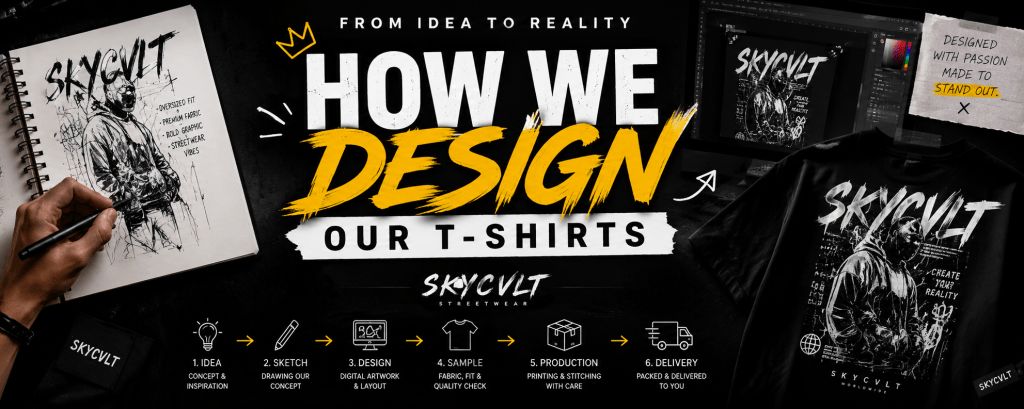
How We Design Our T-Shirts
There’s this assumption people make about streetwear brands — that someone sits in front of a laptop, scrolls through Pinterest for twenty minutes, picks a font, slaps it on a shirt, and calls it a “drop”. Honestly? For a lot of brands, that’s not too far from the truth. For us, it’s never been that simple. Every SKYCVLT piece goes through a process that’s part instinct, part obsession, and part straight-up trial and error.
It Starts With a Feeling, Not a Trend
, “What’sWe don’t open a design session by asking “what’s selling right now.” That question kills originality before it even has a chance. Instead, we ask something messier — what does this piece need to feel like when someone puts it on? Heavy and oversized like armor? Clean and minimal like it’s saying less but meaning more? That feeling becomes the north star for everything that follows: the fabric weight, the cut, the placement of every print.
Sometimes this comes from a late-night conversation about a movie scene. Sometimes it’s a random mood from scrolling through old film photography. We’ve genuinely scrapped designs because they looked “fine” but didn’t feel like anything. Fine doesn’t sell. Fine doesn’t get remembered.
The Sketch Phase Is Where Most Ideas Die
combos, andFor every t-shirt that makes it to production, there are easily five or six that don’t survive past the sketch stage. We draw rough placements, test typography combos, mock up color blocking — and most of it gets killed within a day. This isn’t us being precious about perfection; it’s us refusing to put out something that’s a watered-down version of an idea instead of the real thing.
A lot of brands skip this filtering step because it’s slow and unglamorous. We don’t, because the difference between a design that feels intentional and one that feels like filler is almost always decided right here, before a single sample gets stitched.
Fit Decides More Than People Realize
Graphics get all the attention, but fit is the quiet decision that makes or breaks a t-shirt. Oversized doesn’t just mean “bigger size.” It means rethinking shoulder drop, sleeve length, body length — the whole silhouette has to work together, or it just looks like a regular shirt that’s too big. We go back and forth on fit specs more than people would guess, because a print can be flawless and the shirt can still fail if the drape is wrong.
This is also where wholesale buyers tend to notice the difference. A retailer picking up bulk pieces isn’t just buying a design — they’re buying consistency. If size Large fits like a completely different garment than size Medium, that’s a problem we catch and fix before it ever reaches a rack.
Print Placement Is a Whole Argument On Its Own
We’ve had genuine back-and-forth debates over whether a graphic should sit dead-center on the chest or shifted slightly off-axis. It sounds like a small detail until you see both versions side by side — one feels staged, the other feels lived-in. Placement changes how a design reads from across a room, not just up close.
We also factor in how the print behaves after washing, stretching, and regular wear. A design that looks sharp on a flat mockup but cracks or fades after three washes isn’t a design we’re willing to ship, no matter how good it looked on day one.
Color Isn’t Decoration — It’s a Decision
Color choices get made early, not as an afterthought. A muted off-black reads completely differently than true black under store lighting. Washed greens and dusty browns carry a mood that bright primary colors can’t fake. We test colorways against actual fabric swatches, not just on-screen previews, because screens lie more often than people think.
Then Comes the Part Nobody Sees: Fixing It
Once a design is “done,” it goes through another round of scrutiny — checking alignment, checking how it scales across sizes, checking print quality on actual fabric samples. This stage is unglamorous and repetitive, but skipping it is exactly how brands end up with crooked prints and uneven batches. We’d rather catch the flaw at this stage than have a retailer catch it after unboxing fifty units.
Why This Process Matters for the People Who Stock Us
For retailers and resellers working with us, this process translates directly into fewer headaches. Consistent fit specs, tested print durability, and designs built around intention rather than trend-chasing mean fewer returns and more pieces that actually move off shelves. Streetwear customers can tell the difference between something designed with care and something rushed out to catch a moment — and so can the people selling it.
Designing a t-shirt at SKYCVLT isn’t a quick process, and honestly, we don’t want it to be. The slow parts are usually where the good ideas survive long enough to become something worth wearing.